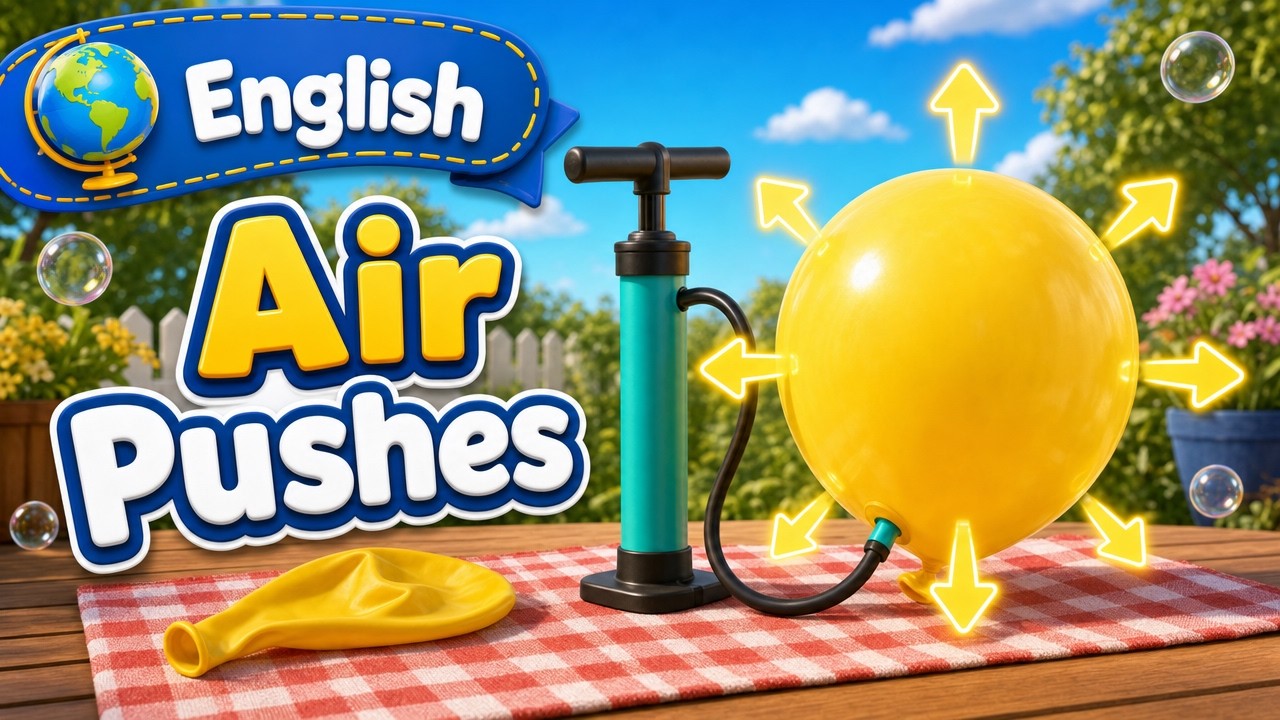
How can invisible air give a balloon its shape? This upbeat science song shows a pump pushing air inside, the air pressing on the stretchy rubber, and one balloon slowly growing.
Text from the recording’s subtitles.
Song lyrics
On ne voit pas l'air : que va-t-il faire au ballon ?
Regardons bien, nous le saurons bientôt.
Le ballon vide est à plat sur la table.
J'enfile le col du ballon sur l'embout de la pompe.
Dès le premier coup de pompe, l'air entre dans le ballon.
On ne le voit pas, mais il y prend de la place.
La pompe fait entrer l'air qu'on ne voit pas,
et cet air appuie sur la paroi en caoutchouc ;
alors le caoutchouc s'étire et le ballon grandit —
cette poussée sur la surface, c'est la pression.
Je pompe de nouveau, tout doucement.
Un peu plus d'air entre dans le ballon.
Le caoutchouc s'étire davantage.
Le ballon, d'abord plat, est presque rond.
Pouvons-nous voir l'air ?
Non, mais nous voyons ce qu'il fait au ballon.
Le ballon s'arrondit et continue de grandir.
L'air appuie sur la paroi dans toutes les directions.
Alors toute la paroi en caoutchouc s'étire.
C'est ainsi que le ballon prend une forme ronde.
La pompe fait entrer l'air qu'on ne voit pas,
et cet air appuie sur la paroi en caoutchouc ;
alors le caoutchouc s'étire et le ballon grandit —
cette poussée sur la surface, c'est la pression.
On ne voit pas l'air, pourtant il appuie vraiment sur la paroi.
C'est pourquoi notre ballon a grandi peu à peu.
Language version lyrics
We can't see the air—what will it do to the balloon?
Let's watch closely; we'll soon find out.
An empty balloon lies flat on the table.
I fit the balloon's neck over the pump nozzle.
With the first push, air goes inside.
Though we can't see it, it takes up space in there.
The pump pushes in the air we cannot see,
and that air presses on the rubber wall,
so the rubber stretches and the balloon grows—
that push on the surface is called pressure.
I push the pump again, slowly and gently.
Another bit of air goes into the balloon.
The rubber stretches more and more.
The flat balloon is now almost round.
Can we see the air?
No, but we can see what it does to the balloon.
The balloon grows rounder and keeps getting bigger.
The air presses in every direction.
So the whole rubber wall stretches.
That's how the balloon takes on a round shape.
The pump pushes in the air we cannot see,
and that air presses on the rubber wall,
so the rubber stretches and the balloon grows—
that push on the surface is called pressure.
Although we can't see the air, it really does press.
That's why our balloon slowly grew.

 3:12
3:12